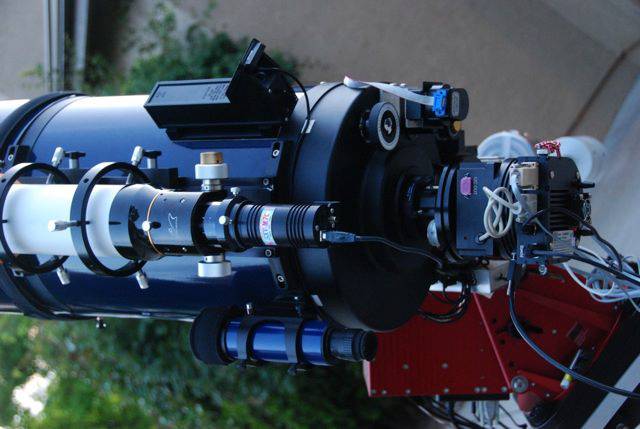
In order to aim a long focal length (i.e., high power) telescope visually, it is necessary to have one or more "finder" scopes mounted to the main tube (and co-aligned with the optical axis of the main scope). In the above picture, a Telrad (boxy black thing at the top) provides 1x finding, the Meade 8x50 finder scope (blue scope at bottom) provides 8x centering of objects, and the Megrez 90 refractor scope (with the camera mounted to it, in the middle) can also be used as a wide-field finder. In addition, I have an SBIG "e-finder" attached to the "remote guide head", which is connected to the SBIG CCD camera. However, now that everything is remotely controlled, I no longer really need a "finder" at all; the remote guide head will eventually be used with a "MOAG" (Astrodon's Monster Off-Axis Guider), which will allow guiding ahead of narrowband filters, allowing faster corrections via the AO-L adaptive optics system. |
Telrad 1x Finder |
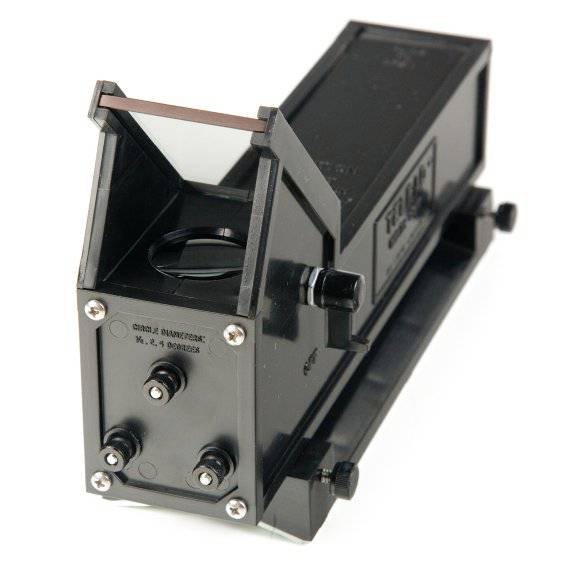 |
The Telrad is a 1-power finder scope. At first, this seems very strange - why 1-power? Basically, you look through the slanted glass (beamsplitter) at the stars - you see exactly what you see normally; however, you also see a projected reticle (bullseye) in the glass (projected from below, through the lens you can see below the beamsplitter). This allows you to easily aim the scope at an object normally and visually - just look through the finder and put the star in the center of the bullseye. Of course, this can only be used with relatively bright stars - that you can easily see with the naked eye. |
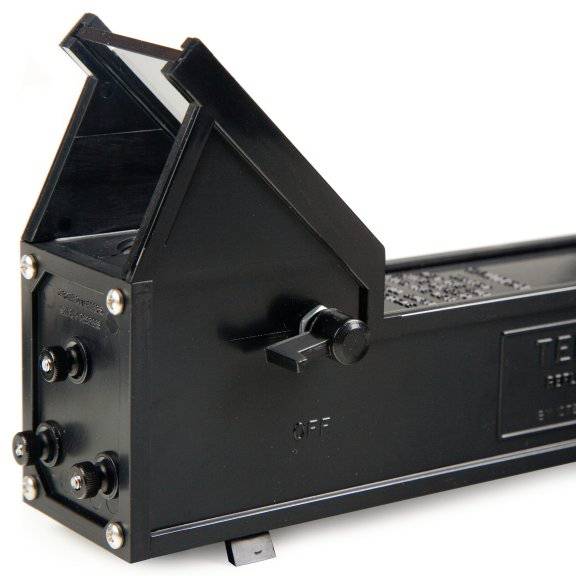 |
The Telrad is boresighted to the scope using the three small screws at the rear of the unit, shown above. Once the scope is aimed precisely (and checked using an eyepiece or a CCD camera, with the object well-centered), the Telrad can be adjusted. The three screws are turned until the star is in the center of the bullseye. From that point on, rough aiming of the scope is very easy. The bulleye rings are 1/2, 2, and 4 degrees; I find it is easy to get the scope aimed to within about 5-10 arcminutes or better - which is sufficient to put a star near the center of most CCD chips. Basically, a Telrad is all that is needed for coarse aiming, with the final positioning done via the CCD camera on the big scope. |
Meade 8x50 Finder |
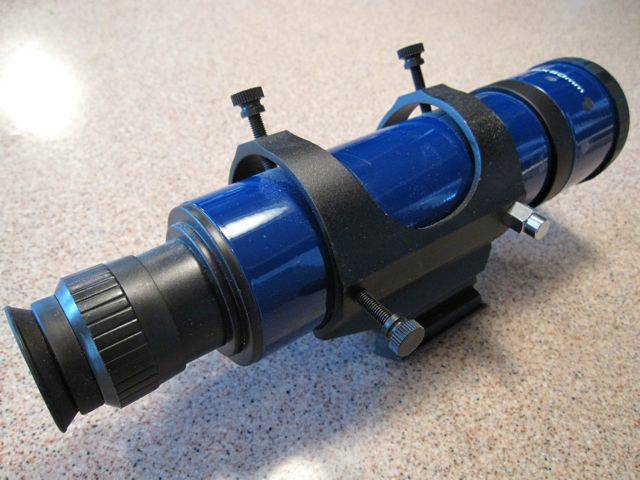 |
The Meade 8x50 finder scope comes standard with most of the LX200 models. It is an 8-power, 50mm diameter scope with crosshairs that allow fine positioning of the main scope. There are at least two versions of these finders; the one shown above has a focusing ring near the eyepiece, while some other versions have the focusing ring on the objective (front of scope). |
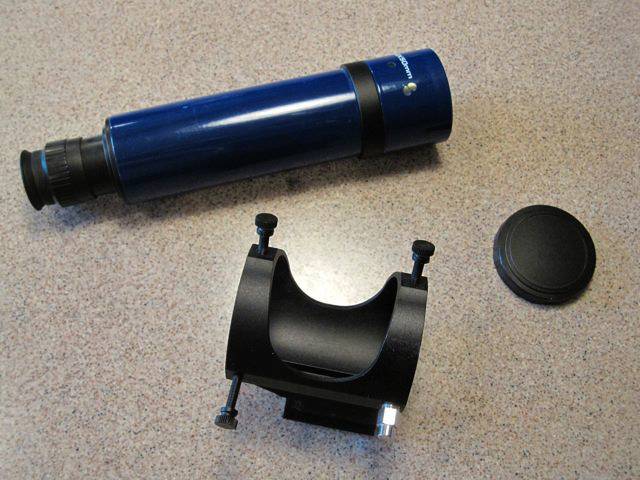 |
The Meade finder scope includes the scope itself, caps for the front and rear, and a mount that allows fine adjustment of the aiming of the finder scope, so that it can be boresighted (co-aligned) with the longer focal length scope. |
SBIG e-Finder |
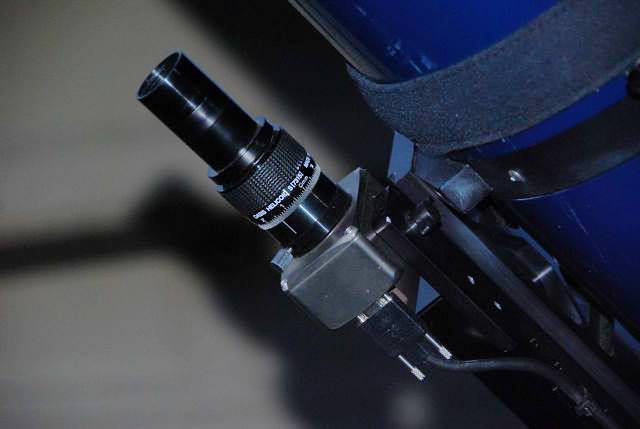 |
The e-Finder is a combination of components that forms a great little finder scope, which is sufficient to guide lower-power scopes (like the 530 mm focal length FSQ-106). It consists of the SBIG remote guide head (silver box in the photo above), which houses a TC237 CCD chip driven by an SBIG camera (such as the ST-4000XCM or STL-11000M); a helical focuser (in this case, a Borg model); and the FR237 focal reducer - which is basically a small telescope. This is mounted at the front of the scope, and has a wide field of view for finding objects that may not fall on the CCD chip. Please refer to: http://www.sbig.com/sbwhtmls/fr237.html I have tried guiding with the e-Finder and, although it works acceptably with short focal-length scopes, it is not sufficient for guiding a long focal length scope like the 12" LX200 (at 3260 mm FL). The e-Finder has an effective focal length of 100 mm; therefore, with a 9 micron per pixel CCD camera, the plate scale is about 18 arcseconds per pixel. With the SBIG AO unit, it is possible to correct the scope to about 0.1-0.2 pixels (this is plus/minus, so actually 0.2-0.4 pixels total). Therefore, with the e-Finder, the scope can be guided with an accuracy of about 3-7 arcseconds. With a short focal length scope, like the FSQ, this would be 1-2 pixels. However, the plate scale of the 12" LX200 and STL-11000M camera is about 0.6 arcseconds per pixel. Therefore, an error of 3-7 arcseconds is equivalent to smearing of the star over 5-10 pixels. This is just too much; using the internal guide chip allows guiding with errors of 0.1-0.2 pixels - but this time the pixels are 0.6arcseconds; therefore the guide error is less than 0.1 arcseconds. The remote guide head can also be used with an off axis guider (OAG), so that guiding can be done in front of any narrowband filters, thereby allowing much more light through, and enabling faster corrections of the adaptive optics than would be possible with the internal guide chip (behind the narrowband filters). |