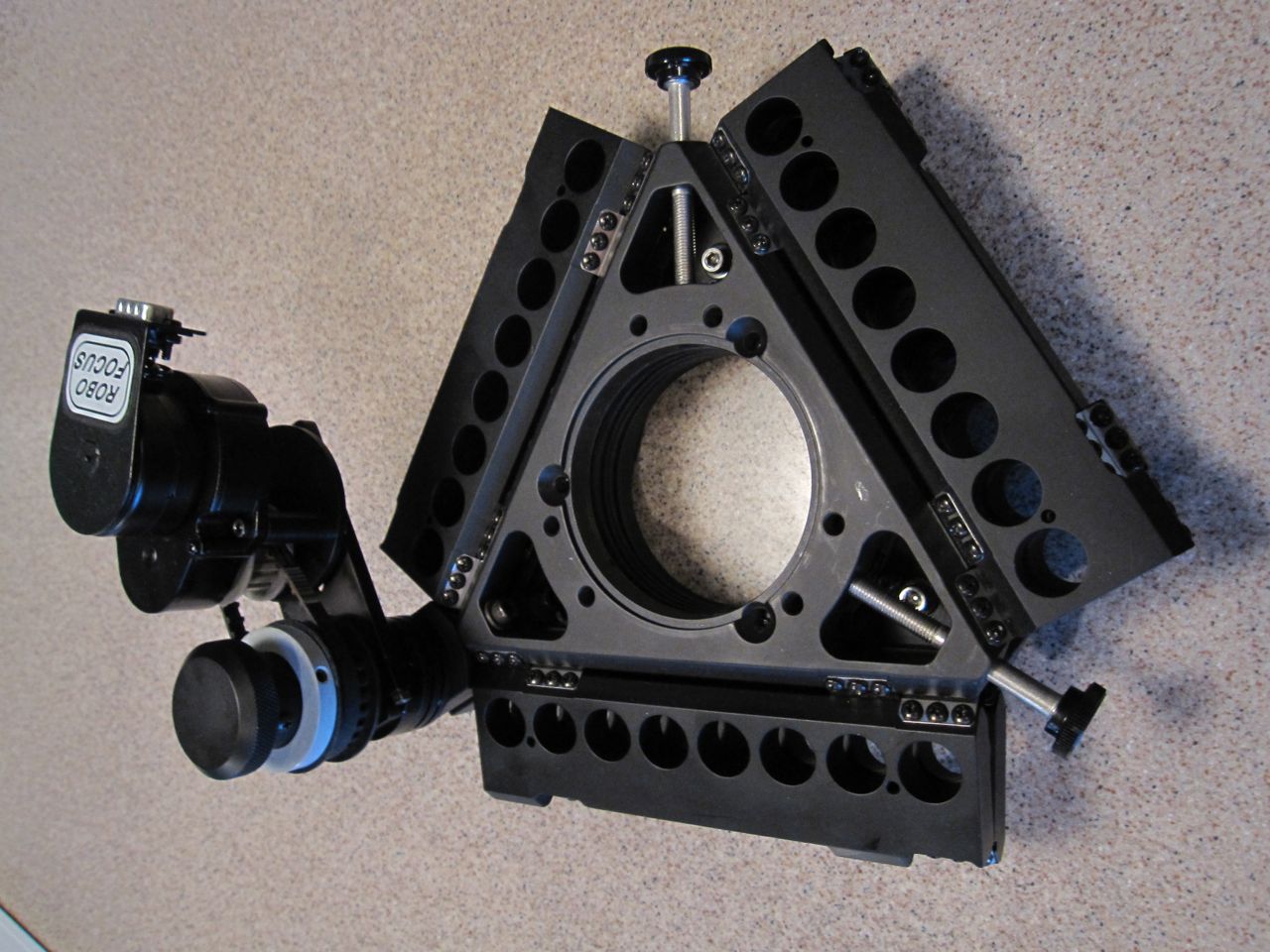
In August 2011, I upgraded the entire optical chain: Bellerophon 3" focuser, Pyxis 3" rotator, Astrodon MOAG and SBIG RGH, FW8 filter wheel, and the original STL-11000M CCD camera. Altogether, it was estimated that my upgraded optical train would weigh about 17-18lbx, so each component needed to be able to support the weight of downstream components. I could have started at the telescope with either the Pyxis 3" rotator or a larger focuser (so the focuser weight doesn't need to rotate, easing the strain on the Pyxis). I chose the Bellerophon 3" RoboFocus-driven focuser made by Don Clement. The Bellerophon 3" (clear diameter) focuser is a 'work of art' in its unique design which allows it to provide precise positioning with minimal backlash, high weight-carrying capability, and linear movement - all without reference to the position of the scope (i.e., loads & moment arms creating stresses on the focuser). It uses a very interesting metal leaf hinge design, as shown in the side view on the photo below. |
New optical train supported by Clement Bellerophon 3" focuser (black object closest to scope). You can see the metal leaf hinges which criss-cross each of the focuser sections. To the right in a vertical position is the RoboFocus motor which moves the focuser via the drive shaft (thin rod seen connecting to focuser). You can see that the focuser is flexed - witht the center 'thicker' than the edges. As the RoboFocus motor drives the shaft, the focuser gets thicker and thinner - or provides exactly the in-out motion required for focusing. Based on the FocusMax V-curves, the motion is quite linear over the middle range of the focuser.
|  |
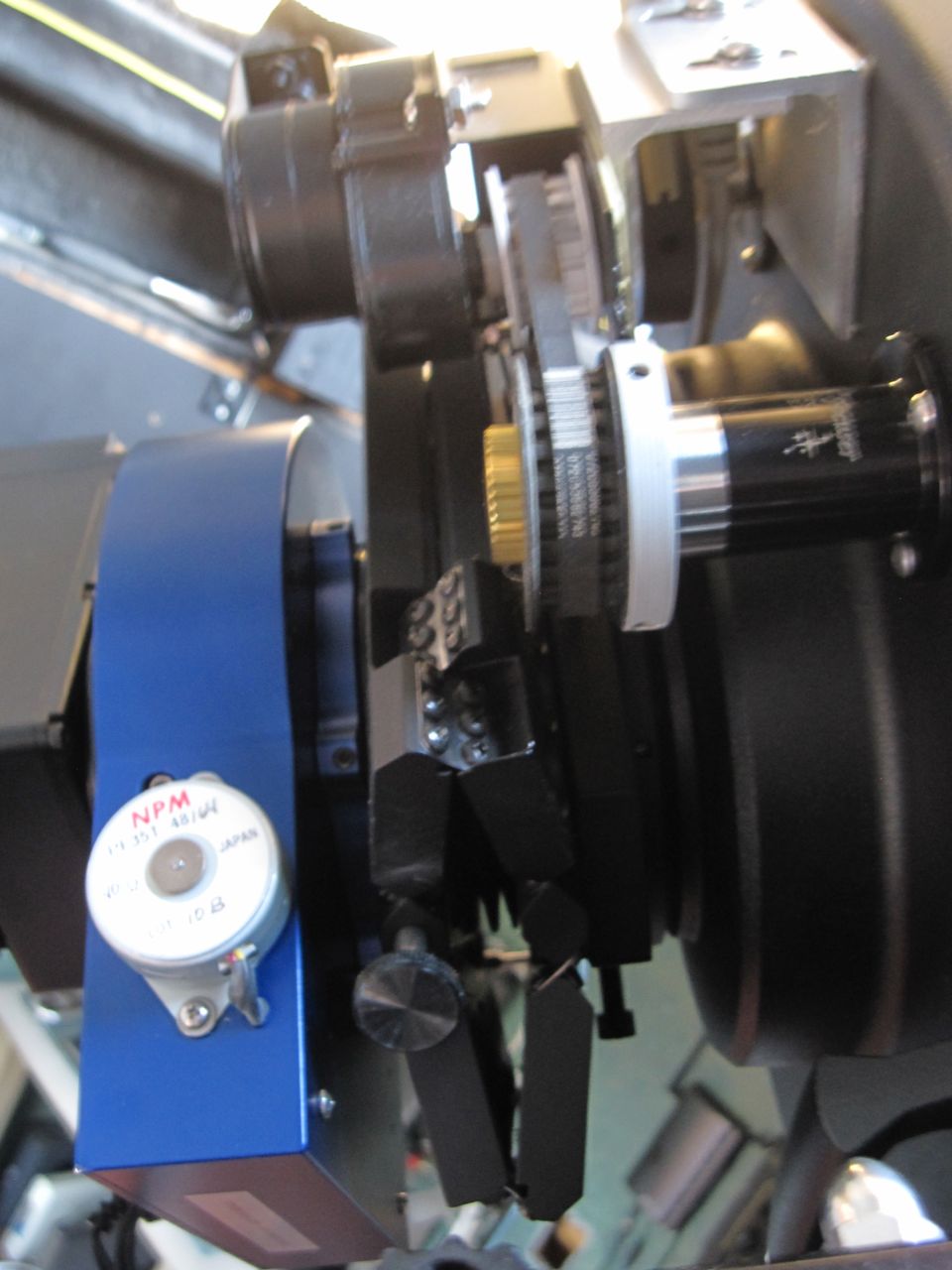 | To the left, you can appreciate the flexing of the Bellerophon via the criss-cross metal leaf hinges (two hinges seen near middle of image with multiple screws attaching to the focuser). Note that the RoboFocus system seen at upper right is not the one driving the Bellerophon, but one I use occasionally to directly drive the primary mirror of the LX200R scope.
|
| The Bellerophon, while providing a full 3" of clearance (for minimum vignetting), is the one of the thinnest focusers available, at 1" (at minimum focus travel). However, it also provides an incredible 1.5" of travel; by comparison, the FLI Atlas focuser, which is 1.25" thick and carries 25lbs, has only a 0.35" total travel. The focal plane (i.e., CCD chip location) for an LX200R (or LX200) scope should be fairly close to the back of the telescope - and not 9-11" from it as shown in the photo to the right. While I haven't seen huge distortions arise, I could probably be getting smaller stars if I were closer to the correct focal length of the scope (3050mm, rather than the 3420mm at which I'm currently operating). | 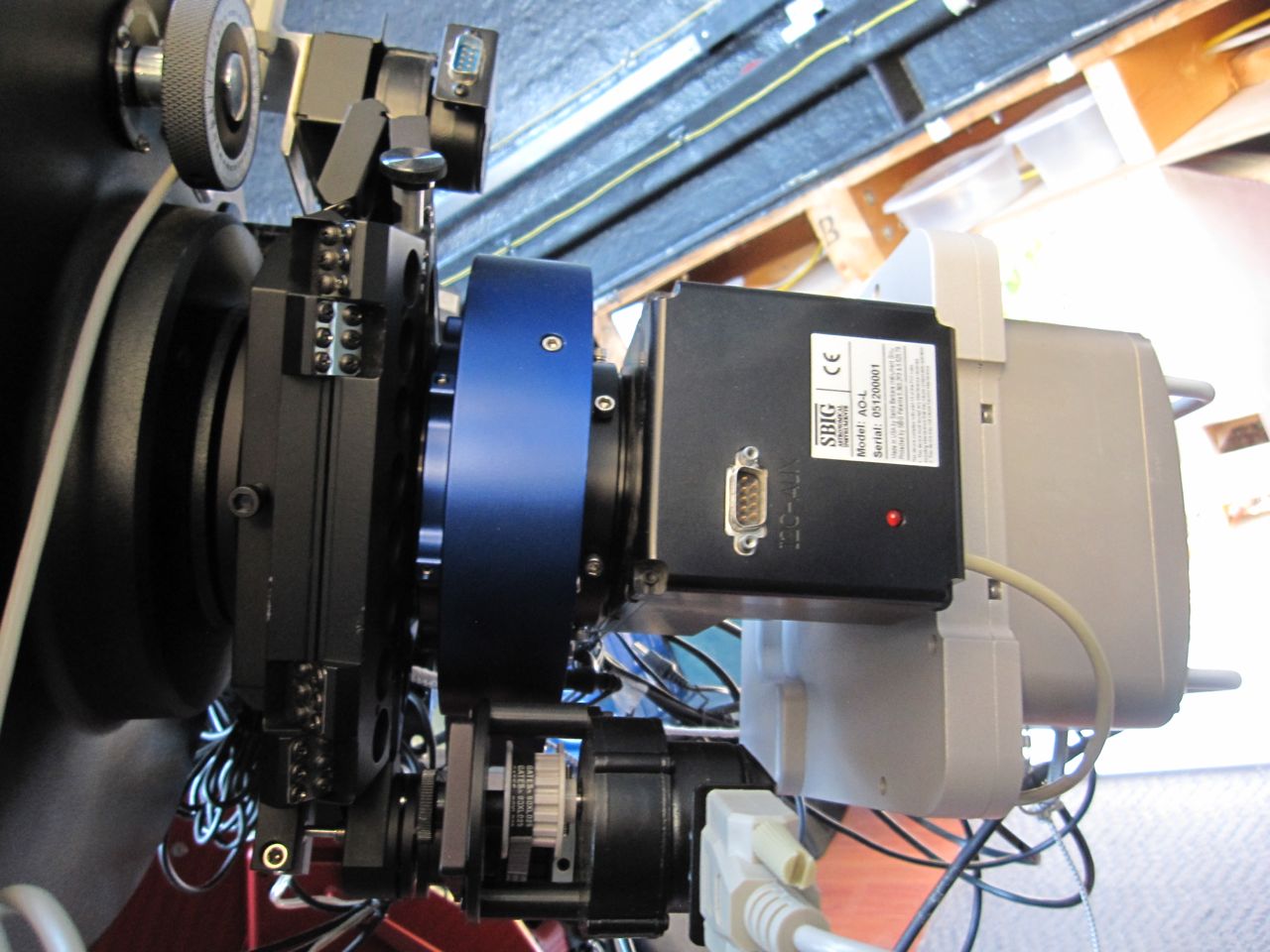 |
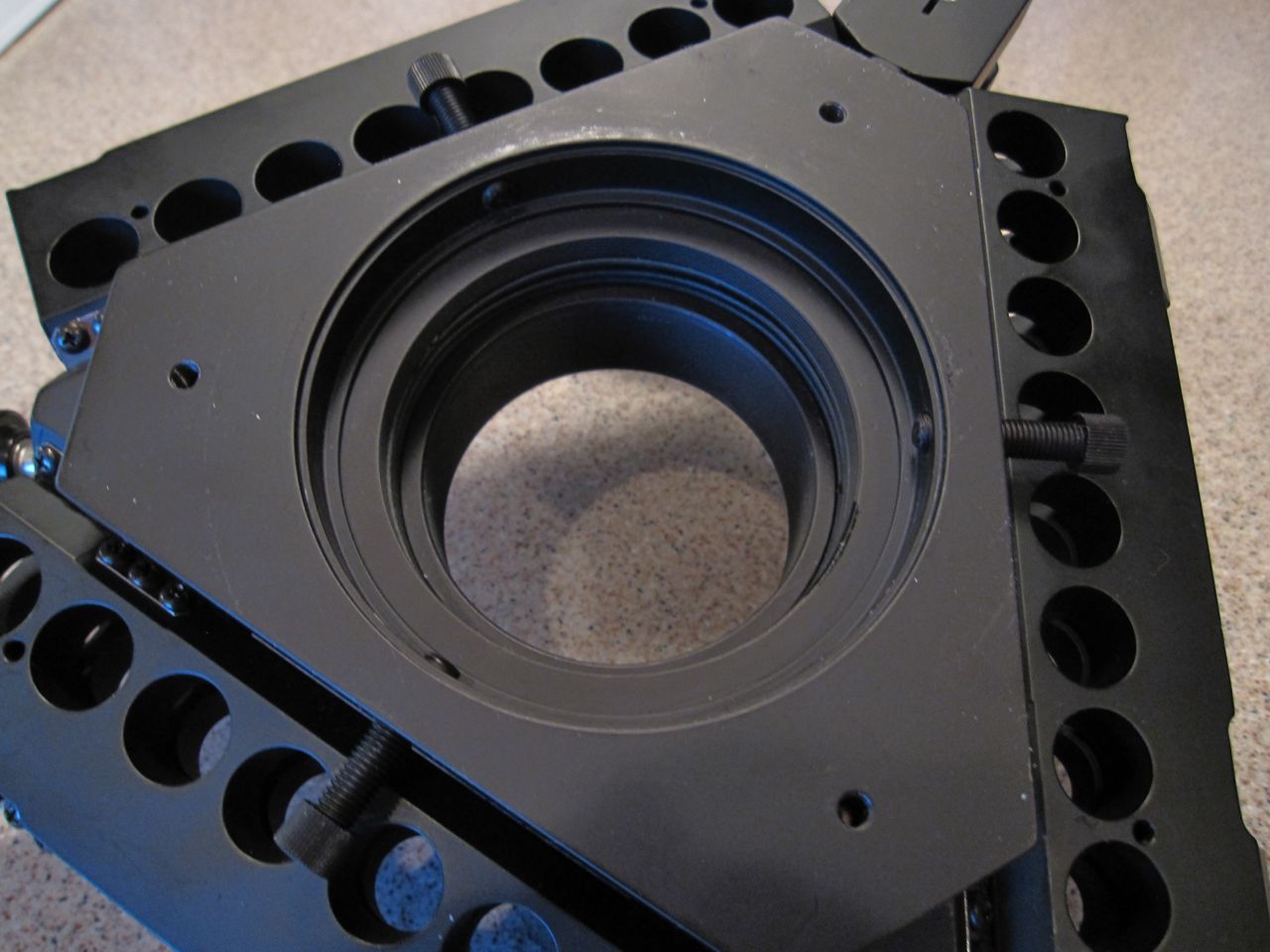 |
Close-up of scope side of Bellerophon 3" focuser. Don Clement made an adapter for me which mates the scope side of the Bellerophon to the Mead 12" telescope back (3.25" 16tpi thread). This adapter first screws onto the scope and is locked onto the scope threads with a nylon set-screws. Then the focuser is mounted onto the adapter, and the three large machine set-screws (seen at the bottom, top, and right edges of the photo at left) are used to tighten the focuser onto the adapter. The adapter has a dovetail which ensures that the focuser does not separate from the scope, even if the set-screws become loose (e.g., due to constant motion of the scope). I had an adapter machined by Ashley Stevens (precseparts.com) which mated the camera side of the Bellerophon to the scope side of the Pyxis 3" rotator. |
At right, you can see the Bellerophon RoboFocus set-up. The RoboFocus motor is at top right, and connected via a sprocket and belt to the focuser drive shaft (and focuser knob which is at right). The drive shaft engages a very fine thread which separates or brings together the two halves of the focuser. The halves flex at the metal hinges seen at top left. The RoboFocus motor is mounted to a cantilevered plate (thin vertical piece in photo), and tension on the belt can be adjusted and locked via the knob to the left of the mounting plate. I have found that the threads are probably too fine (or my RoboFocus set-up not taking big enough steps), as it takes quite a while (e.g., 15-60 sec) for the focuser to move a substantial distance during a FocusMax run. | 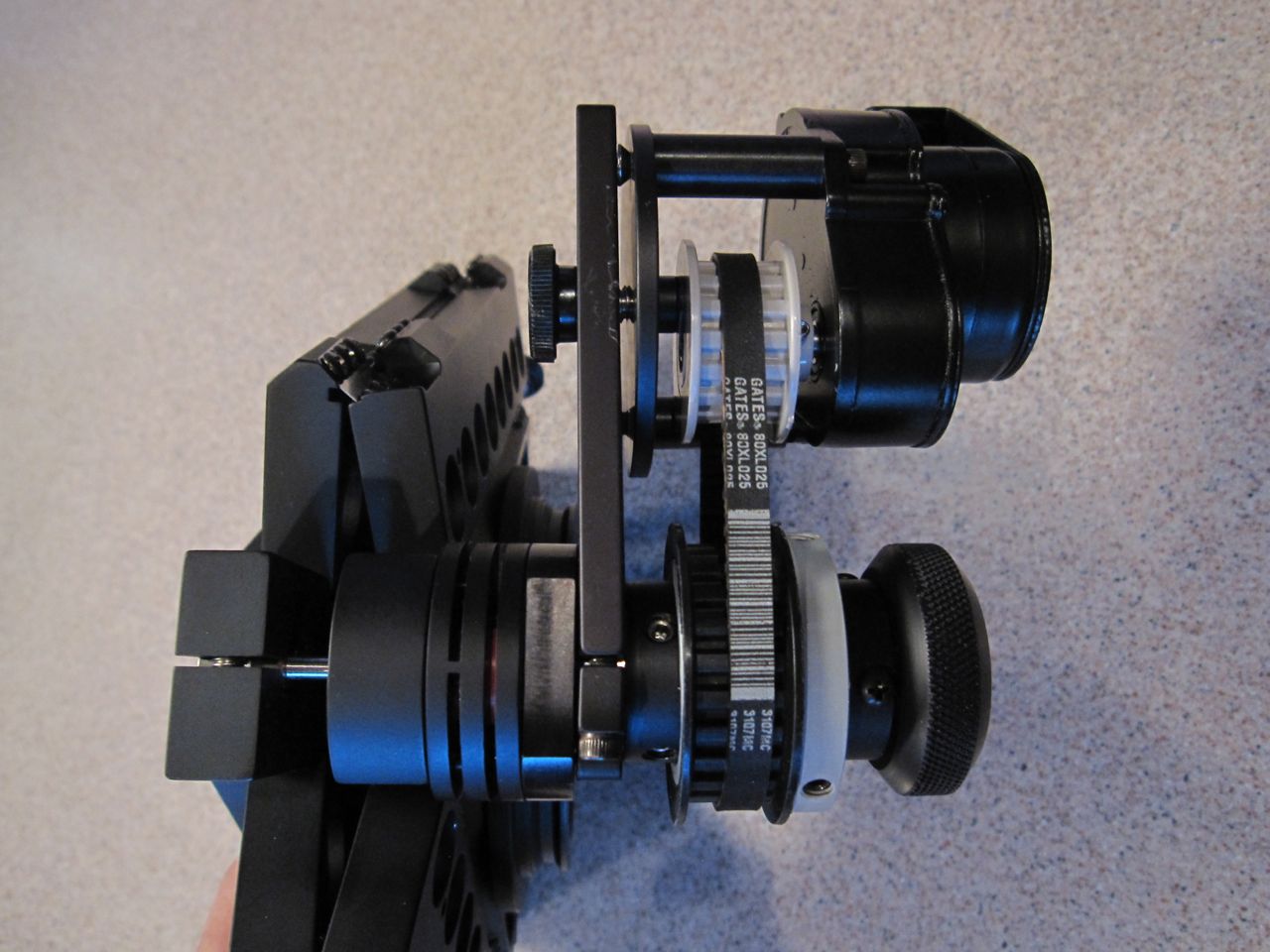 |
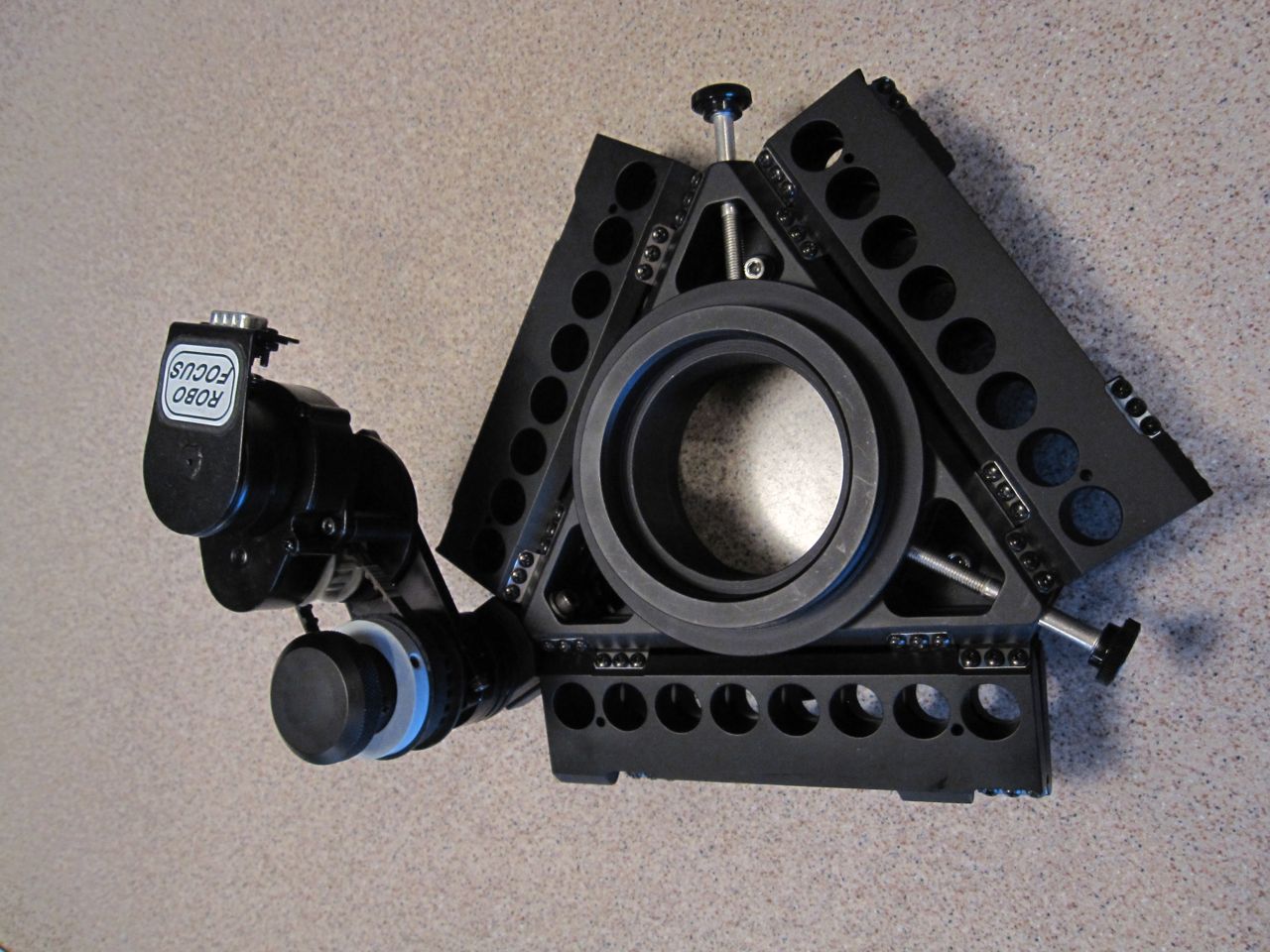 |
When I bought the Bellerophone (via Astromart), an adapter was included that was supposed to be for the 3" Pyxis - which I subsequently bought. However, the adapter - shown mounted on the Bellerophon at left - did not fit the Pyxis (I have no idea what it is for!), so I had to have a special adapter machined by Precise Parts (preciseparts.com), which has a great user interface: you can select the components you want to connect, and the desired connection distance, and the website builds the part for you, provides a drawing and a quote for the part. Very easy! Ashley was great to work with, and provided help and expedited service once the part was ordered. |
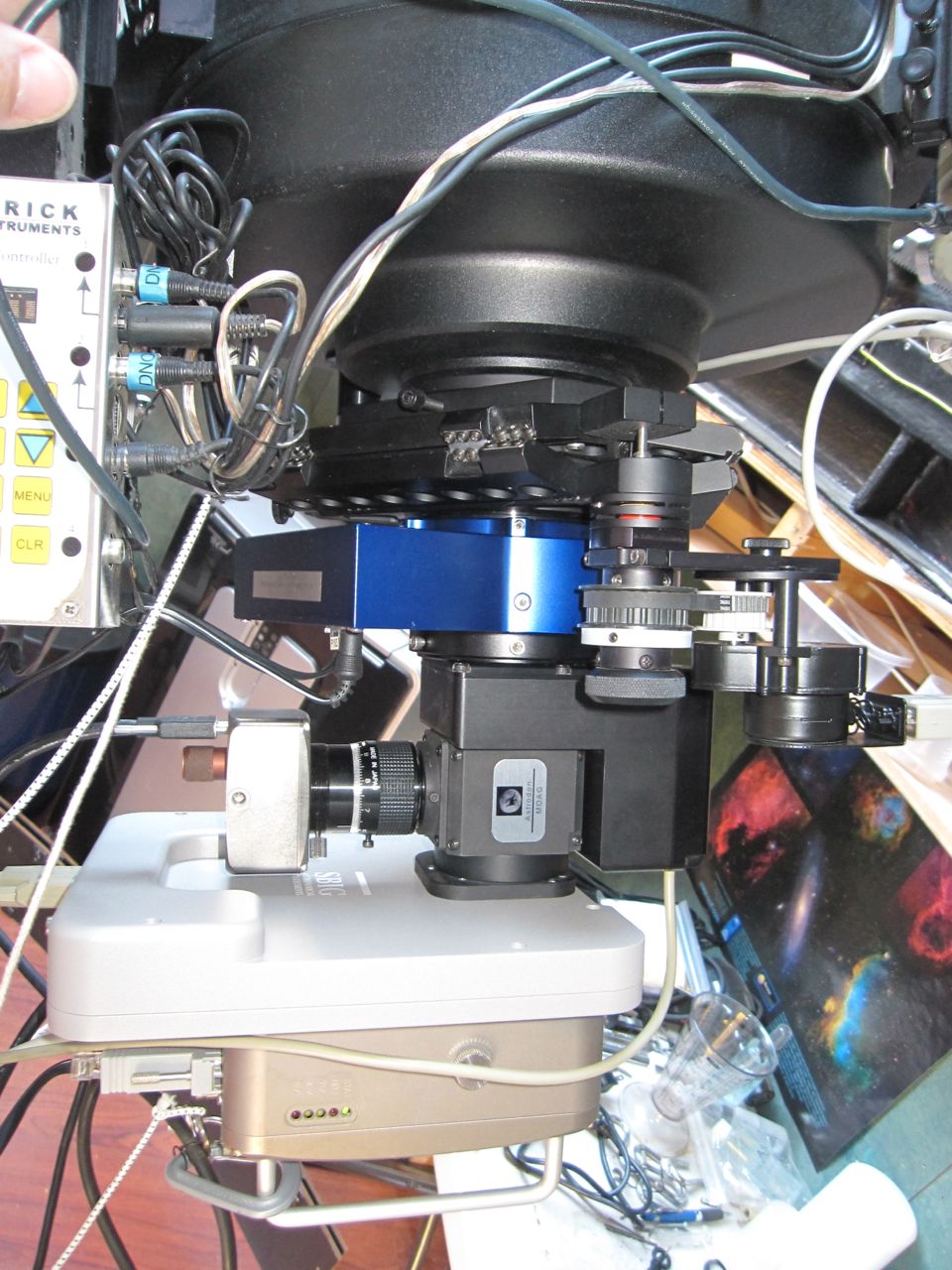
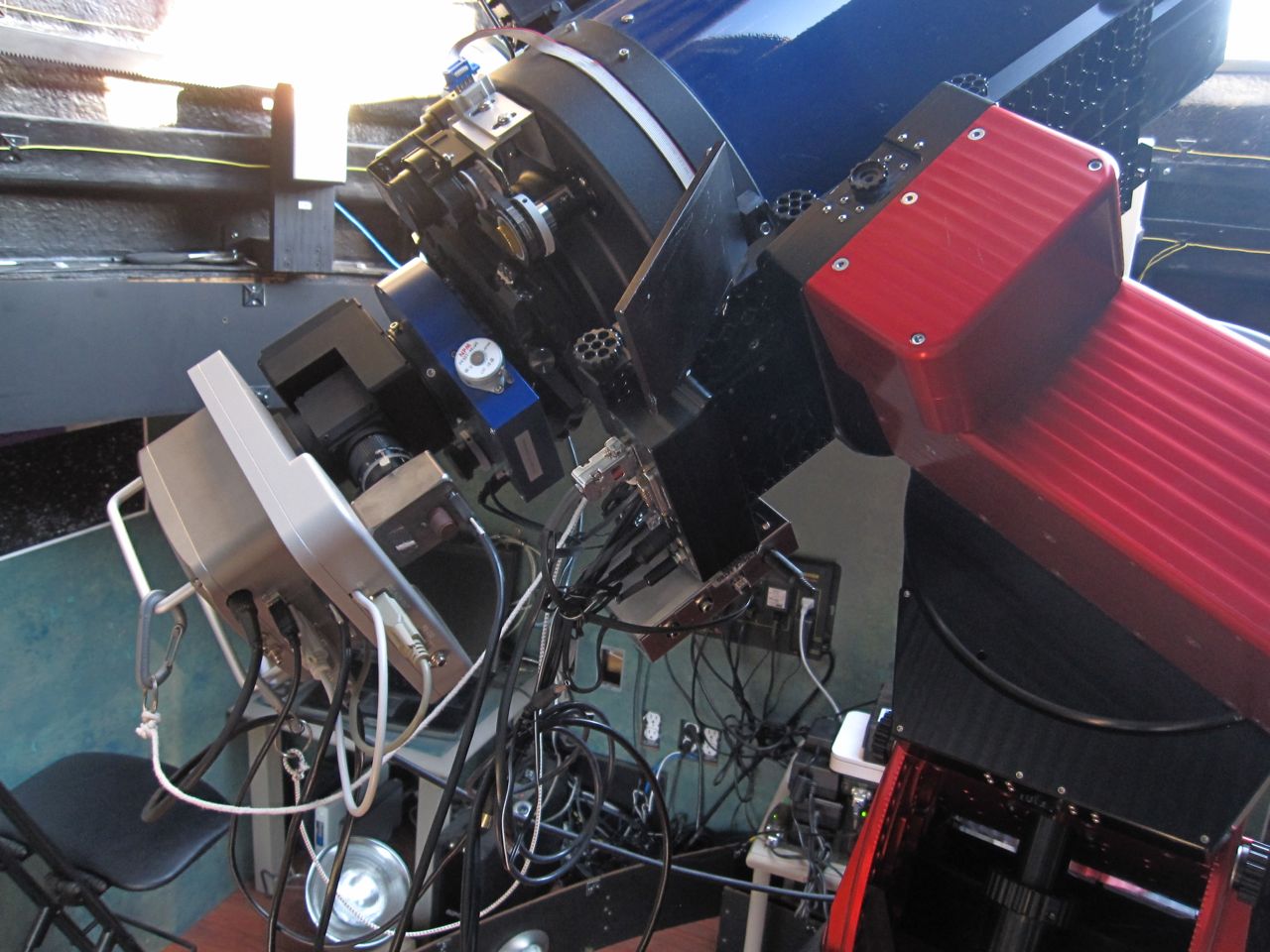
New optical train with more than 15lbs being carried by the Bellerophon 3" focuser. Downstream (to the left) of the focuser is a 3" Pyxis rotator (blue model which was on loan to me while my black version was being machined, anodized and assembled); another adapter - from the Pyxis camera side to the STL 24tpi thread; the AOL adaptive optics unit; the Astrodon MOAG off-axis guider, to which is connected the Borg helical focuser and SBIG Remote Guide Head (small box below MOAG); the FW8 filter wheel (very large unit just to the right of the camera); and STL-11000M camera. While I have two protective cords to the camera, I doubt it could stop the incredible momentum this optical train would build-up on its way to crashing into the Paramount pier! Hopefully, all the set-screws are tight in their dovetails! |
 |